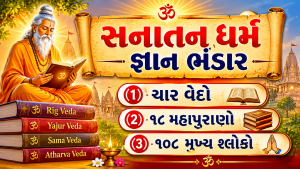
Sanatan Dharma Gyan Bhandar: Sanatan Dharma is one of the world’s oldest living spiritual traditions. Its vast knowledge system is preserved in sacred texts that guide humanity toward truth, dharma, and self-realization. This complete Sanatan Dharma Gyan Bhandar explores the foundation of Hindu wisdom through the Four Vedas, the 18 Mahapuranas, and important sacred shlokas that form the heart of Sanatan teachings.
Whether you are a spiritual seeker, student of Hindu philosophy, or someone looking for authentic Sanatan Dharma knowledge, this guide offers a clear and structured overview of these timeless scriptures.
Table of Contents
The Four Vedas – Foundation of Sanatan Dharma
Sanatan Dharma Gyan Bhandar: The Vedas are the most ancient and authoritative scriptures of Sanatan Dharma. They are considered “Apaurusheya” (not of human origin) and are the root of all Hindu knowledge systems including philosophy, rituals, yoga, and science of life.
| Veda Name | Main Focus | Key Content | Associated Upanishads |
|---|---|---|---|
| Rigveda | Hymns and praises to deities | 10,552 mantras, oldest Veda | Aitareya, Kaushitaki |
| Yajurveda | Rituals and sacrificial procedures | Prose mantras for yajnas | Taittiriya, Brihadaranyaka, Isha |
| Samaveda | Melodies and chants | Musical notes for rituals | Chandogya, Kena |
| Atharvaveda | Daily life, healing, and protection | Spells, medicines, and practical wisdom | Mundaka, Mandukya, Prashna |
The 18 Mahapuranas – Stories of Gods, Creation & Dharma
The Puranas expand Vedic wisdom through stories, cosmology, genealogy of gods and sages, and practical guidance for righteous living. There are 18 major Puranas (Mahapuranas) traditionally attributed to Sage Vyasa.

| No. | Purana Name | Main Deity / Theme | Approximate Verses | Key Teachings |
|---|---|---|---|---|
| 1 | Brahma Purana | Creation and sacred places | 10,000 | Cosmology and tirthas |
| 2 | Padma Purana | Vishnu and sacred geography | 55,000 | Pilgrimage and devotion |
| 3 | Vishnu Purana | Lord Vishnu | 23,000 | Avatars and dharma |
| 4 | Shiva Purana | Lord Shiva | 24,000 | Shaivism and yoga |
| 5 | Bhagavata Purana | Lord Krishna | 18,000 | Bhakti and pure devotion |
| 6 | Narada Purana | Devotion and rituals | 25,000 | Bhakti yoga |
| 7 | Markandeya Purana | Goddess Durga | 9,000 | Devi Mahatmya |
| 8 | Agni Purana | Rituals, medicine, and arts | 15,000 | Practical knowledge |
| 9 | Bhavishya Purana | Future prophecies | 14,500 | Predictions and dharma |
| 10 | Brahmavaivarta Purana | Radha-Krishna | 18,000 | Divine love |
| 11 | Linga Purana | Shiva Linga worship | 11,000 | Shaiva philosophy |
| 12 | Varaha Purana | Lord Varaha | 24,000 | Earth and devotion |
| 13 | Skanda Purana | Lord Kartikeya | 81,000 | Largest Purana, pilgrimage |
| 14 | Vamana Purana | Lord Vamana | 10,000 | Humility and dharma |
| 15 | Kurma Purana | Lord Kurma | 17,000 | Yoga and philosophy |
| 16 | Matsya Purana | Lord Matsya | 14,000 | Creation and architecture |
| 17 | Garuda Purana | Lord Garuda | 19,000 | Afterlife and funeral rites |
| 18 | Brahmanda Purana | Cosmic egg and Lalita | 12,000 | Cosmology and Devi |
108 Main Shlokas – Essence of Sanatan Wisdom
In Sanatan tradition, the number 108 holds deep spiritual significance. While there is no single fixed list of exactly 108 universal shlokas, many important verses from the Bhagavad Gita, Upanishads, and other scriptures are regarded as essential. Below are some of the most revered and widely recited shlokas that capture the core teachings of Sanatan Dharma:
Selected Sacred Shlokas:
- Om Sarve Bhavantu Sukhinah – Prayer for universal well-being
- Vasudhaiva Kutumbakam – The world is one family
- Satyameva Jayate – Truth alone triumphs
- Aham Brahmasmi – I am Brahman (Brihadaranyaka Upanishad)
- Tat Tvam Asi – Thou art That (Chandogya Upanishad)
- Gayatri Mantra – The most sacred Vedic mantra
- Mahamrityunjaya Mantra – Prayer for health and liberation
- Karmanye Vadhikaraste – Focus on action, not results (Bhagavad Gita 2.47)
- Yada Yada Hi Dharmasya – Whenever dharma declines (Bhagavad Gita 4.7)
- Om Namah Shivaya – The five-syllable mantra of Lord Shiva
These shlokas are regularly chanted for peace, protection, clarity, and spiritual growth. Many seekers memorize and meditate upon them as part of daily sadhana.
Why Study These Sacred Texts?
- They provide a complete roadmap for ethical living and spiritual progress
- They answer fundamental questions about life, death, duty, and liberation
- They form the foundation of yoga, Ayurveda, astrology, and Indian philosophy
- Regular study of Vedas, Puranas, and shlokas purifies the mind and strengthens dharma
Sanatan Dharma Gyan Bhandar Links
| Description | Link |
| સનાતન ધર્મ જ્ઞાન ભંડાર | Click Here |
| Join Whatsapp Group | Click Here |
| Home Page | Visit Home Page |
FAQs on Sanatan Dharma Gyan Bhandar Scriptures
1. What are the four Vedas in Sanatan Dharma?
The four Vedas are Rigveda, Yajurveda, Samaveda, and Atharvaveda. They are the oldest and most authoritative scriptures of Hinduism.

2. How many Mahapuranas are there?
There are traditionally 18 Mahapuranas that expand Vedic knowledge through stories and teachings.
3. Which is the most popular Purana?
The Bhagavata Purana is one of the most widely read and loved Puranas because of its focus on devotion to Lord Krishna.
4. What is the significance of 108 in Sanatan Dharma?
The number 108 is considered sacred. It appears in malas (rosaries), Upanishads, and many spiritual practices.

5. Can anyone study the Vedas and Puranas?
Yes. In modern times, authentic translations and commentaries make these texts accessible to sincere seekers of all backgrounds.
6. What is the best way to begin studying Sanatan scriptures?
Start with the Bhagavad Gita, selected Upanishads, and simple translations of the Puranas under the guidance of a knowledgeable teacher.
7. Are the Vedas and Puranas still relevant today?
Absolutely. Their teachings on ethics, self-knowledge, environmental harmony, and inner peace remain highly relevant in the modern world.

The Sanatan Dharma Gyan Bhandar is an ocean of wisdom. By studying the Four Vedas, the 18 Mahapuranas, and the sacred shlokas, one connects with the eternal truths that have guided humanity for thousands of years.